



 English
In mechanical assemblies and fastening systems, even a small component can determine whether equipment runs smoothly or fails prematurely. A Spring washer is one such critical component. Designed to maintain tension, absorb vibration, and prevent fasteners from loosening, spring washers are widely used in machinery, automotive systems, electronics, and industrial equipment.
Although a spring washer may appear simple, its design and manufacturing precision are essential for maintaining equipment stability and extending service life. From a small m3 spring washer used in electronics to larger industrial washers used in heavy equipment, these components play an important role in maintaining secure mechanical connections.
This article will explain what a spring washer is, its working principle, common spring washer types, and how high-precision manufacturing processes ensure reliable performance.
Understanding the Spring Washer
A spring washer is a type of mechanical fastener designed to create tension between a bolt head or nut and the surface it is fastened to. Unlike a Flat washer, which simply distributes load, a spring washer provides elastic force. This elastic force helps maintain pressure in the fastening system and reduces the risk of loosening due to vibration or dynamic loads.
When compressed during installation, the washer stores mechanical energy. As the assembly experiences movement or vibration, the washer continues applying pressure, helping the bolt or nut remain tight.
A common example is the spring lock washer, which features a split design that creates friction and tension. When the bolt is tightened, the washer’s edges press against both the bolt head and the surface, preventing rotational loosening.
Because of their ability to maintain tension and absorb vibration, spring washers are widely used in motors, industrial equipment, electronic devices, and automotive assemblies.
Common Spring Washer Types
There are several spring washer types, each designed for specific mechanical requirements.
1. Belleville Spring Washers
Belleville spring washers, also known as disc springs, have a conical shape that allows them to provide high load capacity in a compact space. These washers are often used in applications requiring high spring force and minimal deflection.
Industries frequently use custom belleville washers when standard specifications do not meet special load or dimensional requirements. These customized washers can be designed for precise compression forces and stacking configurations.
2. Wave Spring Washer
A wave spring washer has a wavy structure rather than a flat or conical shape. This design allows it to provide a smooth and consistent spring force with less axial space.
Wave spring washers are commonly used in compact mechanical assemblies such as electric motors, small gearboxes, and precision instruments.
3. Conical Washer
A conical washer functions similarly to Belleville washers but may have slightly different geometry or load characteristics depending on the application. The conical shape allows the washer to compress and generate spring force when tightened.
These washers are often used in high-load applications where vibration resistance and tension maintenance are essential.
4. Spring Lock Washer
The spring lock washer is one of the most common types of spring washers. Its split design allows the washer to exert pressure and friction against mating surfaces, preventing Bolts from loosening under vibration.
This washer type is widely used in mechanical equipment, electrical components, and automotive parts.
5. Small Precision Washers
Small-sized washers, such as the m3 spring washer, are commonly used in electronic products, small motors, and precision devices. Despite their tiny size, these washers play a critical role in preventing loosening in delicate assemblies.
Why Manufacturing Quality Matters
Although spring washers appear simple, their performance depends heavily on precise manufacturing processes. Even slight deviations in thickness, hardness, or surface quality can affect their ability to maintain tension and resist wear.
A high-quality washer must provide:
Accurate dimensions
Consistent spring force
Proper hardness and strength
Smooth surfaces without burrs
Strong corrosion resistance
To achieve these requirements, manufacturers rely on strict production processes and quality inspection systems.
The Birth of a Precision Washer: 14 Processes and 4 Quality Stamps
A seemingly tiny shaft washer or spring washer actually plays a vital role in equipment stability and longevity. Its core function is to adjust clearances and reduce friction. If the washer quality is poor, it may lead to abnormal wear, vibration, or noise in mechanical systems.
Because of this, professional manufacturers devote great attention to every production detail.
From raw material selection to final inspection, the creation of a washer often involves 14 production steps and four quality verification stages, forming a complete quality control loop.
1. Raw Material Preparation
Production begins by retrieving specified steel strips from a strictly managed raw material area. Common materials include 65Mn, SK5, and SK7 spring steel, each chosen for its strength, elasticity, and wear resistance.
Every material batch is clearly identified and stored according to classification standards to ensure traceability.
2. Mold Setup
Experienced technicians carefully install high-precision molds onto the stamping press. Ensuring perfect mold alignment—both parallel and vertical—is critical for producing dimensionally accurate washers.
3. Stamping
Once the mold setup is complete, the stamping press begins operation. Steel strips are instantly stamped into individual washers using precision dies.
Operators continuously monitor the stamping process to maintain stable production and consistent product quality.
4. First Article Inspection
Before full production begins, the first sample from each batch undergoes strict inspection.
Quality engineers use optical image measuring equipment to verify all dimensions against engineering drawings. Only when the first piece meets all specifications can mass production proceed.
During production, inspectors also perform hourly sampling checks to maintain consistent quality.
5. Initial Grinding for Small Washers
For washers with an outer diameter of 7 mm or less, a preliminary grinding process is performed. This step ensures a smooth surface and prevents stacking issues that could cause uneven plating later.
6. Grinding Quality Inspection
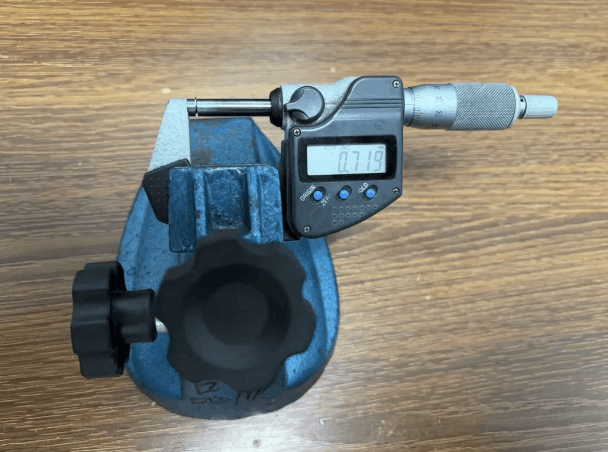
After the first grinding step, inspectors measure washer dimensions using micrometers. Once the parts pass inspection, the process receives the first quality approval stamp.
7. Heat Treatment
Heat treatment is one of the most critical steps in washer manufacturing. It modifies the internal structure of the material to achieve the required hardness, strength, and wear resistance.
Depending on the application, washer hardness may reach HRC 43–50.
8. Heat Treatment Inspection
After heat treatment, inspectors test hardness using a Vickers hardness tester. Products meeting the specified hardness range receive the second quality approval stamp.
9. Secondary Grinding
Washers undergo further grinding after heat treatment to ensure flatness and precision according to engineering specifications.
10. Grinding Inspection
Quality inspectors measure the finished washers using micrometers and calipers to check for burrs, flash, or dimensional deviations. Passing products receive the third quality approval stamp.
11. Electroplating
Washers are then sent for electroplating processes such as zinc plating or nickel plating. This improves corrosion resistance and enhances appearance.
12. Plating Inspection
After electroplating, inspectors examine coating color, adhesion, and surface quality. Approved products receive the fourth quality stamp.
13. Optical Sorting and Manual Inspection
Before packaging, washers undergo CCD optical sorting and manual inspection to eliminate defective parts.
14. Packaging and Final Quality Check
Finally, qualified products are packaged according to customer requirements. Before shipment, quality teams conduct a final sampling inspection to verify labels, quantities, and specifications.
Applications of Spring Washers
Thanks to their vibration resistance and tension-maintaining capabilities, spring washers are used in many industries:
Automotive engines and transmission systems
Electric motors and generators
Industrial machinery
Electronics and appliances
Construction equipment
Aerospace assemblies
From custom belleville washers used in high-load industrial equipment to small m3 spring washer components in electronics, spring washers are essential for maintaining reliable fastening systems.
Conclusion
A spring washer may appear to be a small and simple component, but it plays a vital role in ensuring mechanical stability, reducing vibration, and extending equipment life.
With multiple spring washer types such as spring lock washer, wave spring washer, belleville spring washers, and conical washer, engineers can select the most suitable design for different applications.
Behind every high-quality washer lies a rigorous manufacturing process—from raw material control and precision stamping to heat treatment, grinding, plating, and strict quality inspections. A production system consisting of 14 manufacturing processes and four quality verification stages ensures consistent performance and reliability.
For industries that demand precision and durability, investing in high-quality spring washers is essential for long-term equipment stability and operational efficiency.