



 English
Spring Washers in Rotary Shaft Hinges: Working Principle & Key Functions
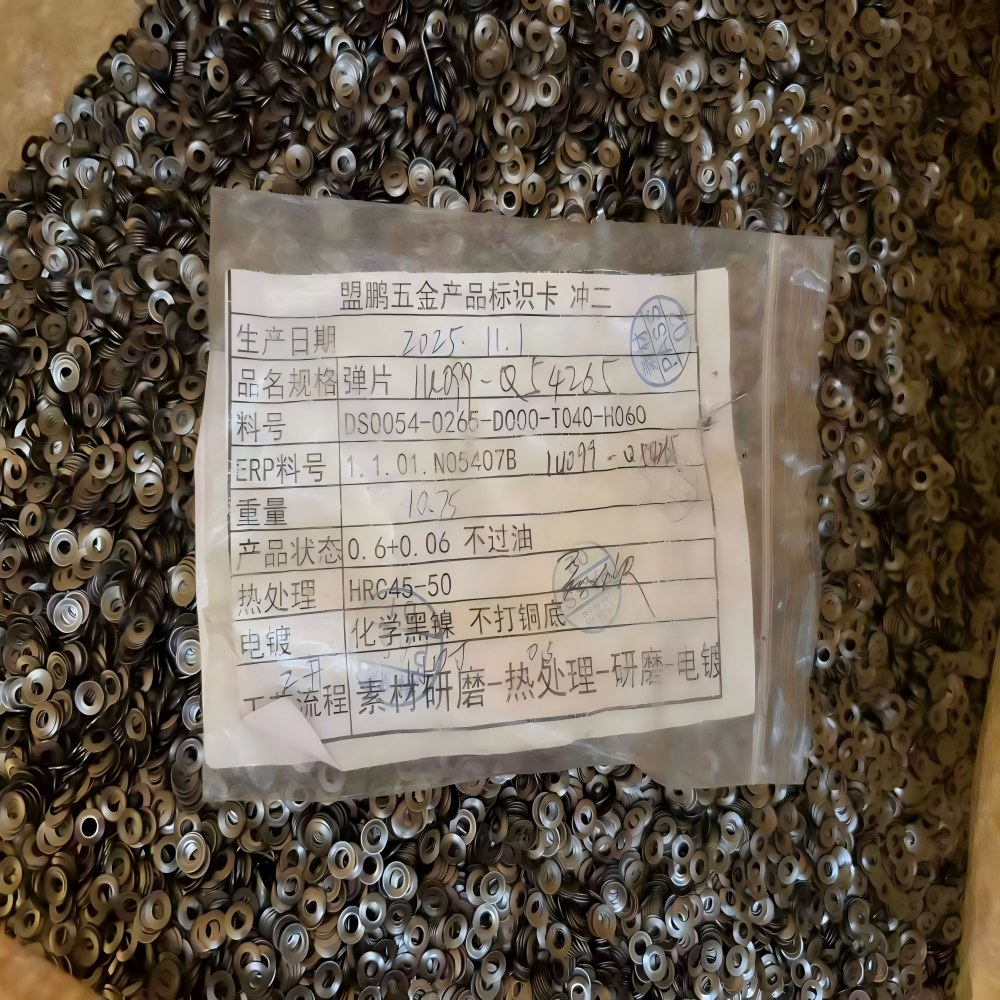
What Are Spring Washers in Rotary Shaft Hinges?
In industrial design and hinge manufacturing, spring washers (also widely called spring plates) are arched or dome‑shaped elastic metal components used inside rotary shaft hinges. Unlike Flat Washers, they are not straight but have a curved, convex structure that deforms elastically under compression to create stable torque for the hinge system.
These parts are critical for laptops, monitors, home appliances, automotive interiors, medical devices, and various precision equipment where smooth and stable rotation is required.
Size Range: From Large to Micro Spring Washers
Spring washers for rotary shafts come in a very wide size spectrum to meet different product designs:
Outer diameter range: from 30mm (large hinges) down to 3mm (miniature structures)
Ultra‑micro specification: available as small as 1.7mm outer diameter for ultra‑compact precision hinges
Various thicknesses and curvatures to adjust torque intensity
This wide sizing flexibility makes spring washers suitable for everything from large industrial equipment to tiny consumer electronics hinges.
Core Working Principle: How Spring Washers Generate Hinge Torque
The function of spring washers in a rotary shaft hinge follows a clear physical mechanism:
Spring washers have an arched or dome shape—they are not flat.
When the shaft assembly is locked by a nut, the spring washer is compressed and deformed.
Compression changes the washer’s thickness and creates a strong elastic rebound force.
This rebound force produces consistent friction between contact surfaces, which directly creates the stable torque of the rotary shaft hinge.
In short: Torque of the hinge = compression deformation of the spring washer = elastic rebound force = stable damping force.
Key Functions of Spring Washers in Rotary Shaft Assemblies
1. Generate Stable and Controllable Torque
Spring washers are the primary source of torque in most friction hinges. By changing material, thickness, curvature, and quantity, designers can precisely adjust torque from light touch to heavy duty, ensuring the hinge stays at any angle without sagging or shaking.
2. Maintain Preload and Prevent Loosening
The continuous elastic force keeps the entire shaft assembly tightly clamped. This effectively prevents loosening caused by vibration, repeated opening/closing, or long‑term use—greatly improving durability and service life.
3. Compensate for Manufacturing Tolerances
Micro deformation of spring washers automatically compensates for tiny gaps or dimensional errors in machining and assembly, ensuring consistent performance even in mass production.
4. Improve Smoothness and Hand Feel
Elastic support delivers even pressure distribution, making rotation smoother, quieter, and more comfortable—critical for high‑end consumer electronics and home appliances.
5. Extend Hinge Service Life
By reducing direct metal‑to‑metal wear and absorbing impact forces, spring washers significantly lower fatigue and extend the overall lifecycle of the hinge mechanism.
Spring Washer vs Flat Washer: Comparison Table
| Feature | Spring Washer (Spring Plate) | Flat Washer |
|---|---|---|
| Structure | Arched, curved, dome‑shaped | Flat, straight, no curvature |
| Core Function | Generate torque, anti‑loosening, elastic support | Distribute load, protect surface |
| Elasticity | High elastic deformation ability | Almost no elasticity |
| Use in Hinges | Must‑have for torque hinges | Auxiliary only |
Typical Applications of Spring Washers in Hinges
Consumer electronics: laptop hinges, tablet stands, monitor arms
Home appliances: oven doors, refrigerator lids, coffee machine hinges
Automotive: glove boxes, armrests, sun visors, interior trim hinges
Furniture: cabinets, folding tables, recliner mechanisms
Industrial & medical: control panels, diagnostic equipment arms, adjustable fixtures
Design & Selection Tips for Industrial Designers
Choose outer diameter based on hinge size: from 1.7mm micro to 30mm large models
Select thickness and curvature to match required torque level
Use stainless steel or spring steel for high elasticity and corrosion resistance
Stack multiple spring washers to increase torque output
Ensure consistent compression during assembly to avoid uneven force
Conclusion
Spring washers (spring plates) are the core functional component that determines the performance of a rotary shaft hinge. Their arched structure, elastic deformation, and rebound force create stable, reliable torque for smooth positioning and long service life.
For industrial designers, structural engineers, and product developers, understanding the working principle and function of spring washers is essential to designing high‑quality, durable, and user‑friendly hinge systems.