



 English
In precision hinge systems, washers may appear to be simple mechanical components, but they play a critical role in controlling torque, improving durability, and creating the desired opening and closing experience. For applications such as laptops, tablets, monitors, automotive displays, and industrial equipment, selecting the correct hinge washer directly affects product performance and user experience.
A well-designed hinge requires more than just a shaft and screw assembly. The combination of friction washer, Hook Washer, cam washer, Spring Washer, and Flat Washer determines the friction force, preload stability, angle positioning, and service life of the hinge system.
Different washer structures provide different functions. Some washers are designed to increase friction torque, some improve lubrication performance, while others provide angle limitation or compensate for assembly tolerance. Understanding the differences between each type helps engineers select the right solution for their hinge design.
Mengpeng Parts specializes in manufacturing precision hinge components, including friction washers, hook washers, Torque Washers, cam washers, and customized stamped metal parts. With professional manufacturing experience, the company provides reliable washer solutions for consumer electronics, automotive, and industrial hinge applications.
Why Hinge Washers Are Important in Torque Control
The main function of a hinge washer is to control the relationship between friction force and rotational movement. During hinge operation, the washer creates controlled resistance between metal components, allowing the hinge to maintain a stable position instead of moving freely.
A properly selected washer can provide several important advantages:
Stable hinge torque during repeated opening and closing cycles
Smoother rotational movement and improved user feeling
Reduced metal-to-metal wear and operating noise
Better compensation for assembly tolerance
Longer hinge service life
More consistent performance in mass production
For example, a laptop hinge requires a different washer solution compared with an automotive display hinge. A lightweight notebook may prioritize smooth movement and silent operation, while a vehicle display system may require higher torque, stronger positioning force, and better vibration resistance.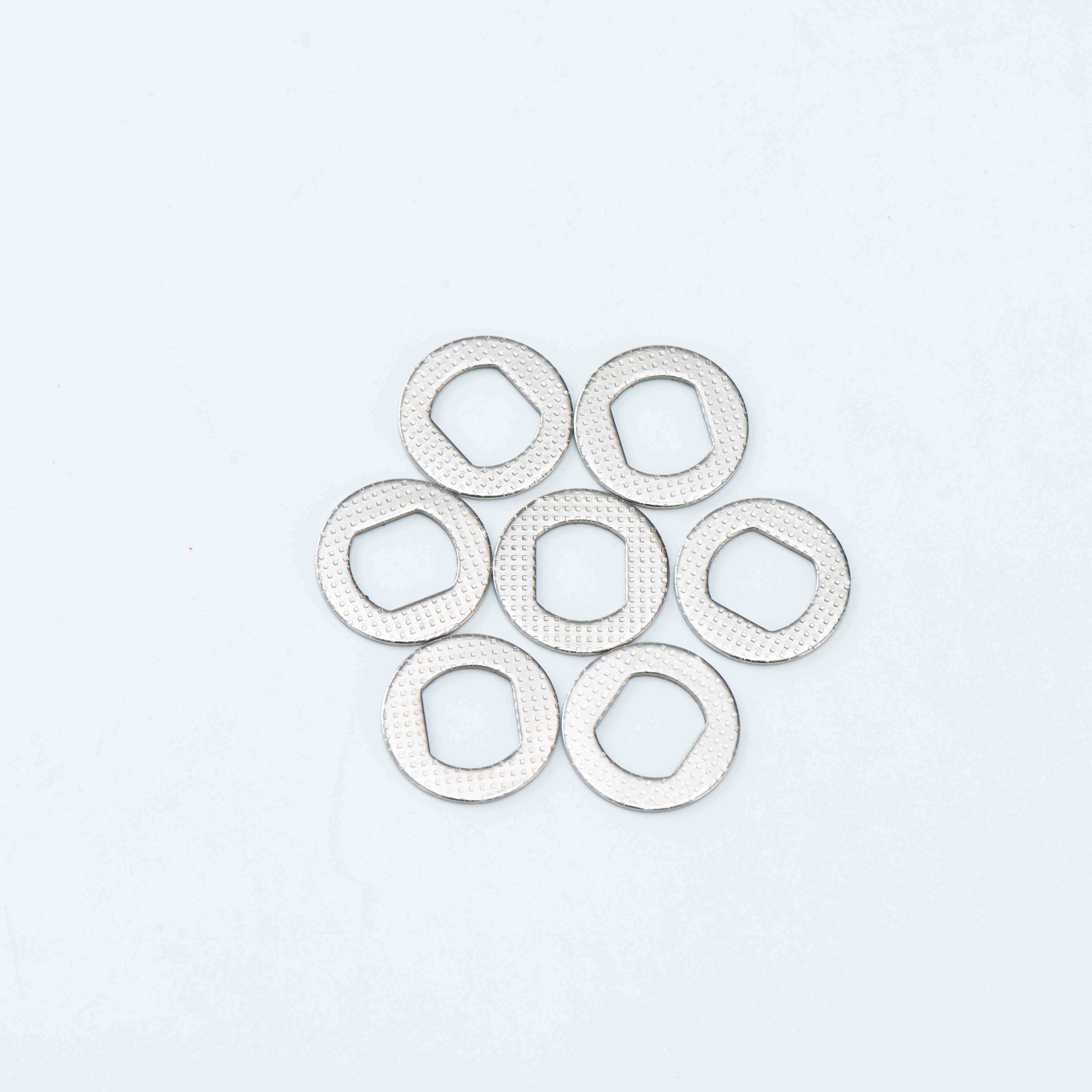
1. Standard Flat Washer: Basic Support and Torque Adjustment
The standard flat washer is one of the most commonly used components in hinge assemblies. Although it does not create high friction torque by itself, it plays an important supporting role in the overall structure.
Its main functions include:
Distributing axial pressure: The flat washer spreads the locking force from the nut or screw, preventing damage to soft aluminum brackets or plastic supports.
Protecting structural surfaces:It prevents direct contact between metal parts and reduces surface deformation caused by concentrated pressure.
Improving contact stability:The washer helps compensate for small surface unevenness, allowing more uniform force distribution.
Fine torque adjustment:Multiple washers with different thicknesses can be combined to achieve precise torque tuning.
Standard flat washers are commonly used in conventional laptop hinges, tablet hinges, and other rotating mechanisms where stable friction performance is required without additional angle positioning functions.
2. Oil Groove Friction Washer: Improving Smoothness and Durability
For high-end hinge applications requiring quiet operation and long-term stability, an oil groove friction washer is often a better choice than a standard flat washer.
This type of friction washer features specially designed grooves on the surface. These micro oil reservoirs store lubricant during operation, continuously improving lubrication between friction surfaces.
The advantages include:
Reduced dry friction and operating noise
Smoother opening and closing movement
More stable torque after long-term use
Reduced wear between contacting surfaces
Improved hinge reliability
Oil groove friction washers are widely used in premium laptops, portable monitors, and compact electronic devices where users expect smooth, silent, and durable hinge performance.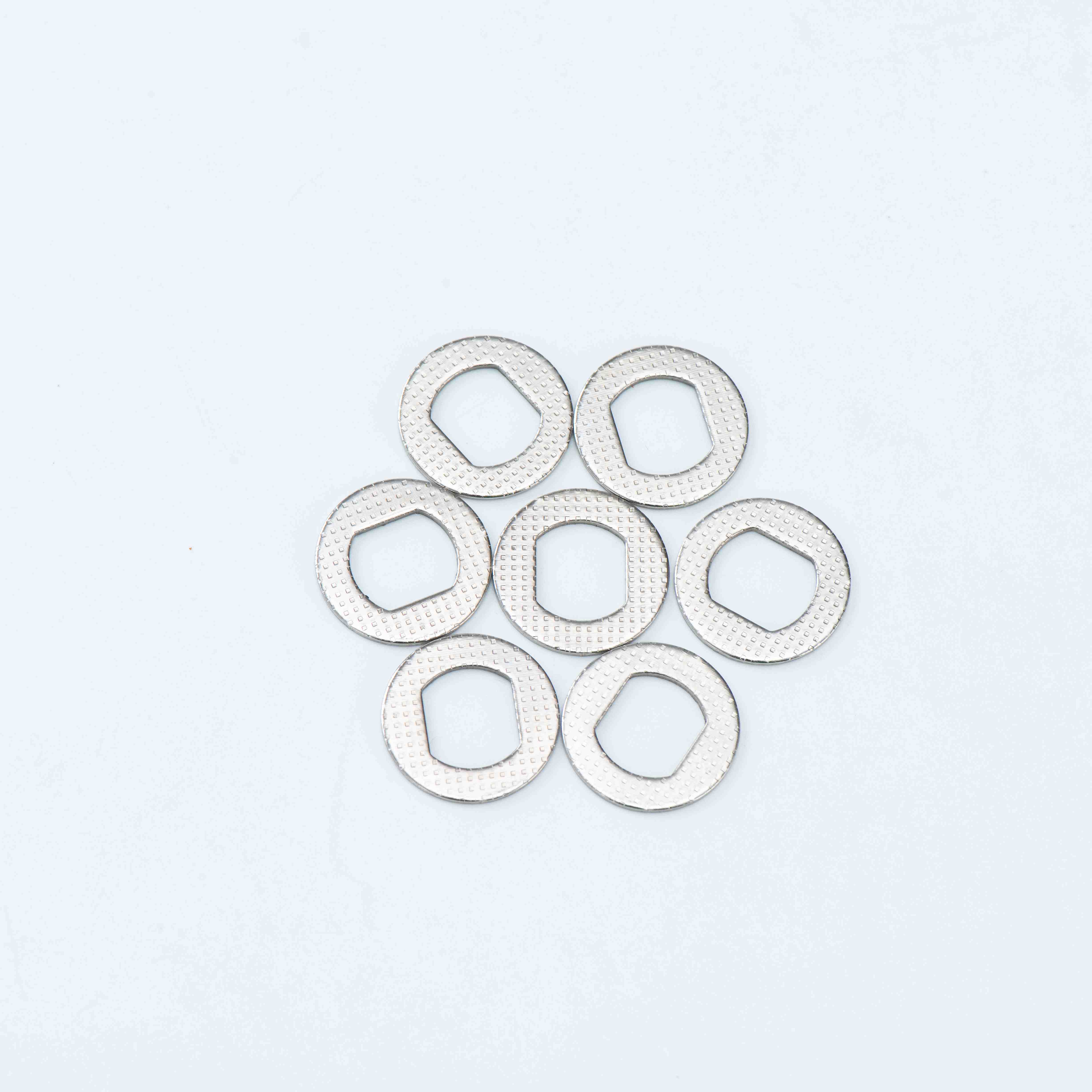
3. Hook Washer: Combining Torque Control and Angle Limitation
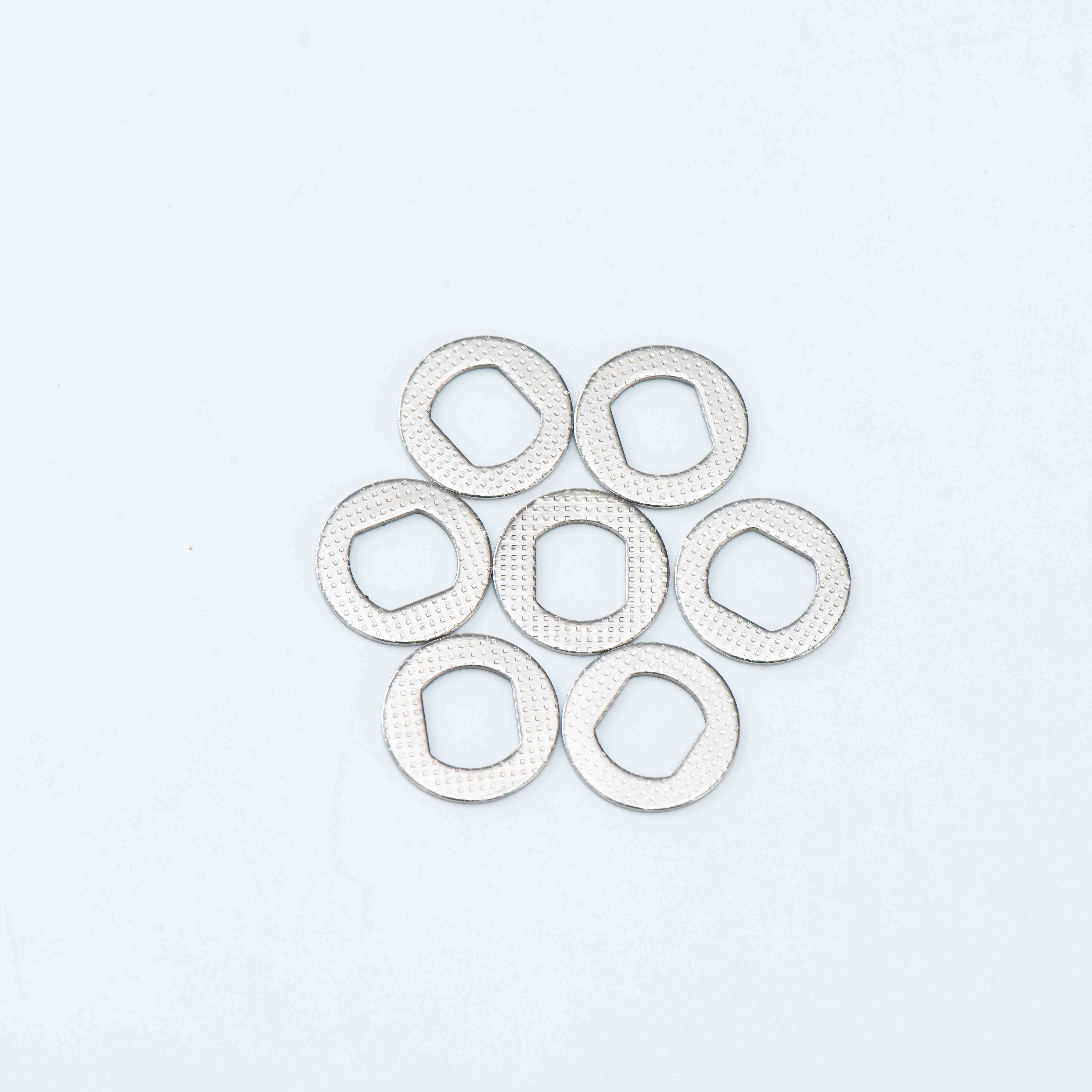
A hook washer is a specially designed hinge washer with an extended tab or hook structure on the edge. Unlike a standard flat washer, the hook design allows the washer to engage with a matching slot or support structure inside the hinge assembly, creating additional positioning control.
The biggest advantage of a hook washer is that it combines two functions in one component: friction torque control and mechanical angle limitation. This reduces the number of separate parts required in the hinge system and simplifies the overall structure.
During hinge operation, the friction surface provides rotational resistance, while the hook structure works as a stopper to control the maximum opening angle. Depending on the hinge design, it can achieve different opening limits such as 120°, 135°, or 180°.
Key advantages of hook washers include:
Integrated angle positioning:Eliminates the need for additional mechanical stop components.
Stable opening limitation:Prevents excessive rotation that may damage cables, screens, or structural parts.
Space-saving design:Combines multiple functions into one precision stamped component.
Improved assembly efficiency:Reduces the number of hinge parts and simplifies production processes.
Hook washers are commonly used in laptop screen hinges, tablet stands, POS equipment, lighting brackets, and other applications where controlled opening angles are required.
4. Double Hook Friction Washer: Higher Torque and Two-Way Positioning
For applications requiring higher torque and bidirectional positioning, engineers often choose a double hook friction washer. This design includes friction surfaces on both sides together with double-side hook structures, allowing the hinge to achieve stronger resistance and more stable positioning.
Compared with a single hook washer, the double hook structure provides enhanced mechanical stability because both rotation directions can be controlled. This makes it suitable for products that require frequent adjustment, folding, and multi-angle positioning.
Main performance benefits include:
Higher torque output:Double friction surfaces provide stronger resistance for heavier components.
Two-way rotation control:Both forward and reverse movements can achieve stable positioning.
Better load support:Suitable for larger screens and heavier hinge structures.
Enhanced durability:Balanced force distribution reduces uneven wear.
Double hook friction washers are commonly applied in convertible laptops, dual-screen devices, folding tablets, and adjustable support structures where strong torque and reliable positioning are required.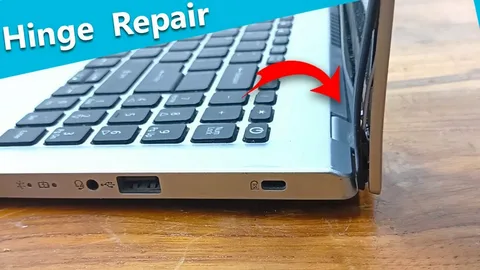
5. Cam Washer: Creating Multi-Stage Torque and Self-Locking Functions
A cam washer is a special type of torque control washer designed with uneven cam surfaces. Unlike traditional flat friction washers that provide relatively constant resistance, cam washers create changing torque characteristics during rotation.
When two matching cam surfaces move against each other, the hinge can produce different resistance levels at different angles. This creates a unique stepped feeling, allowing users to experience different opening forces during operation.
For example:
At 30° opening angle: lower resistance for smooth movement.
At 90° position: increased holding force for stable positioning.
At 135° or maximum angle: stronger resistance to prevent accidental movement.
This special torque curve makes cam washers ideal for premium products that require differentiated user experience, such as high-end business laptops, convertible tablets, and adjustable display systems.
Compared with standard friction washers, cam washer systems provide more precise control over hinge movement and can achieve functions similar to mechanical gear positioning while maintaining a compact structure.
6. Concave Spring Washer: Maintaining Long-Term Preload Stability
A spring washer, especially a concave spring washer design, is not primarily used to generate friction torque. Instead, its main function is to provide continuous elastic preload and compensate for dimensional changes during long-term operation.
During repeated hinge movement, friction surfaces may experience minor wear or material deformation. Without compensation, the locking force may gradually decrease, resulting in reduced torque and loose hinge movement.
A concave spring washer helps solve this problem by maintaining continuous pressure inside the hinge assembly.
Its main functions include:
Compensating assembly tolerance variations
Maintaining stable axial pressure
Reducing torque loss caused by wear
Preventing loosening during vibration or long-term operation
It is important to note that a spring washer does not independently create hinge torque. It should be used together with a friction washer or torque control washer to achieve both stable preload and controlled rotational resistance.
Spring washers are commonly used in high-cycle applications such as vehicle displays, industrial equipment hinges, and other mechanisms requiring long-term reliability.
How to Choose the Right Hinge Washer for Your Application
Selecting the correct hinge washer depends on the required torque level, operating environment, product structure, and expected service life. Different washer designs solve different engineering problems, so choosing the right type during the design stage can significantly improve hinge reliability and user experience.
| Washer Type | Main Function | Torque Performance | Typical Applications |
|---|---|---|---|
| Standard Flat Washer | Distributes pressure, protects support structures, basic torque adjustment | Stable medium torque | Standard laptop hinges, tablet hinges, general rotating mechanisms |
| Oil Groove Friction Washer | Stores lubricant, reduces noise, improves durability | Higher torque with smoother operation | Premium laptops, portable monitors, silent hinge applications |
| Hook Washer | Provides friction and mechanical angle limitation | Medium torque with positioning function | Laptop screens, POS devices, adjustable brackets |
| Double Hook Friction Washer | Two-way positioning and stronger friction control | High torque | Convertible laptops, folding tablets, dual-screen devices |
| Cam Washer | Creates multi-stage torque and self-locking feeling | Variable torque according to angle | High-end business laptops, adjustable displays |
| Spring Washer | Maintains preload and compensates wear | Auxiliary component, not independent torque source | High-cycle and vibration environments |
Common Design Mistakes When Using Hinge Washers
Although washers are small components, incorrect selection or assembly methods can cause unstable torque, abnormal noise, and premature hinge failure. Engineers should consider the following points during design and validation.
1. Using Thin Washers on Soft Support Structures
When a hinge is installed on soft aluminum brackets or plastic structures, excessive concentrated pressure may cause deformation. Using a thicker flat washer helps distribute the locking force and protects the supporting structure.
2. Ignoring Lubrication Requirements
For products requiring silent operation and long service life, standard steel washers may not provide sufficient performance. An oil groove friction washer can store lubricant and maintain smoother operation during repeated cycles.
3. Adding Separate Stop Components Instead of Using Hook Washers
If the hinge requires opening angle control, adding external stop blocks may increase the number of components and complicate assembly. A properly designed hook washer can integrate torque control and angle limitation into one component.
4. Using Cam Washers Without Proper Matching Design
Cam washers normally work as matched pairs. Incorrect cam geometry or poor alignment may result in unstable torque changes, uneven wear, or poor user experience.
5. Treating Spring Washers as Friction Components
A common misunderstanding is that spring washers can independently create hinge torque. In reality, their primary purpose is maintaining preload. They should always be combined with friction surfaces such as a friction washer to achieve stable torque control.
Recommended Hinge Washer Assembly Structure
A typical torque hinge assembly may include multiple washer types working together. The correct combination depends on the required torque, angle control, and durability requirements.
Support Bracket → Friction Washer → Hook Washer (Optional) → Spring Washer → Flat Washer → Locking Nut
In this structure:
The friction washer provides the main torque resistance.
The hook washer provides angle limitation when required.
The spring washer maintains long-term preload stability.
The flat washer protects the supporting structure and improves force distribution.
Why Choose Mengpeng Parts for Custom Hinge Washers?
Mengpeng Parts focuses on precision manufacturing of friction washers, hook washers, torque washers, cam washers, and custom stamped metal components. With professional experience in hinge component development, the company provides reliable solutions for customers requiring accurate torque control and long-term durability.
The company supports customized solutions including:
Customized washer dimensions based on hinge structure requirements
Different material options for various friction and durability requirements
Precision stamping with stable thickness and dimensional control
OEM and ODM services for prototypes and mass production
Engineering support for torque optimization and structural improvement
Whether you need a standard hinge washer or a customized torque control washer solution, Mengpeng Parts can help optimize your hinge design from prototype development to large-scale manufacturing.
Conclusion
Different types of washers serve different functions in hinge design. Standard flat washers improve structural stability, friction washers control torque, hook washers provide angle limitation, cam washers create multi-stage movement, and spring washers maintain long-term preload.
Choosing the right washer combination allows engineers to achieve the ideal balance between smooth operation, stable torque, durability, and user experience. For modern electronic devices and precision mechanical systems, a properly designed washer solution is one of the key factors behind a high-quality hinge.