



 English
65Mn vs SK5 vs SK7: Material Selection Guide for Precision washers
When specifying precision washers, material selection directly affects dimensional stability, hardness, wear resistance, fatigue performance, and service life. For applications involving repeated loading, friction, or controlled axial force, choosing the right steel is just as important as selecting the correct washer dimensions and manufacturing process.
Among the materials commonly used for stamped and precision-engineered washers, 65Mn, SK5, and SK7 are three options worth considering. However, they are not interchangeable in every application. The appropriate material depends on the required hardness, spring characteristics, wear resistance, forming requirements, and operating conditions.
For manufacturers and OEM buyers sourcing custom washers, understanding these differences can help reduce premature wear and improve assembly performance.
1. What Are 65Mn, SK5, and SK7?
65Mn is a manganese-alloyed carbon spring steel widely used where good elasticity, strength, and fatigue resistance are required. It is particularly suitable for components that undergo repeated loading or need to maintain a stable spring force.
SK5 and SK7 are Japanese JIS carbon tool steel grades. Their relatively high carbon content allows them to achieve good hardness and wear resistance after heat treatment. They are commonly considered when a washer needs greater resistance to deformation or repeated contact.
The three materials can therefore be summarized as follows:
| Material | General Characteristics | Typical Advantage |
|---|---|---|
| 65Mn | Carbon-manganese spring steel | Elasticity and fatigue resistance |
| SK5 | High-carbon tool steel | Hardness and wear resistance |
| SK7 | High-carbon tool steel | Strength, hardness and balanced machinability |
The final performance, however, depends not only on the steel grade but also on heat treatment, thickness, stamping accuracy, surface treatment, and dimensional tolerances.
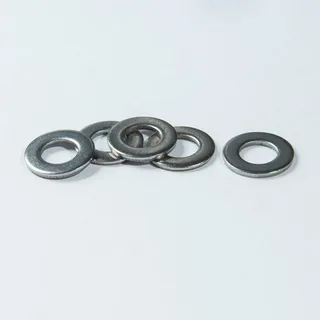
2. 65Mn Washers: When Elasticity and Fatigue Resistance Matter
65Mn is a practical choice for applications where the washer must withstand repeated loading while maintaining its mechanical properties.
For example, 65Mn washers can be considered for spring-loaded assemblies, mechanical fastening systems, friction mechanisms, and components subjected to repeated compression or axial movement.
Its main advantages include:
Good elastic properties
Good fatigue resistance
High strength after heat treatment
Suitable performance under repeated loading
Good balance between performance and manufacturing cost
For a friction washer, the ability to maintain stable contact pressure can be particularly important. If the washer is used inside a hinge or rotating mechanism, material selection should be evaluated together with the required torque, hardness, surface finish, and assembly structure.
3. SK5 Washers: A Good Option for Wear-Resistant Applications
SK5 is a high-carbon tool steel that can achieve relatively high hardness after appropriate heat treatment.
For precision washers exposed to repeated friction, contact pressure, or mechanical wear, SK5 can be an attractive material option.
Typical advantages include:
High hardness after heat treatment
Good wear resistance
Good strength
Suitable for precision stamped components
Useful for applications requiring dimensional stability
This makes SK5 washers worth considering for applications where surface durability and resistance to deformation are more important than maximum elasticity.
For example, SK5 may be evaluated for friction washers, Hook Washers, lock washers, and custom stamped washers used in compact mechanical assemblies.
However, higher hardness does not automatically mean better overall performance. The material still needs to match the required forming process and working conditions.
4. SK7 Washers: Balancing Hardness and Mechanical Performance
SK7 is another high-carbon tool steel used for components requiring strength and hardness.
Compared with simply choosing the hardest available material, engineers should consider the complete operating environment when specifying SK7 washers.
Factors such as:
Required hardness
Washer thickness
Load conditions
Contact pressure
Frequency of movement
Stamping complexity
Required dimensional tolerance
Surface treatment
can all influence the final material decision.
For custom applications, SK7 can be evaluated when the washer needs a combination of hardness, strength, and stable dimensional performance.
5. 65Mn vs SK5 vs SK7: Which One Should You Choose?
There is no universal “best” material for every precision washer.
A better approach is to select the material according to the primary performance requirement.
| Requirement | Recommended Material to Evaluate |
| Repeated elastic loading | 65Mn |
| Good fatigue performance | 65Mn |
| Higher wear resistance | SK5 |
| High hardness requirement | SK5 / SK7 |
| Repeated friction contact | SK5 / 65Mn |
| Spring-like performance | 65Mn |
| Precision stamped components | 65Mn / SK5 / SK7 |
| Custom mechanical assemblies | Select according to load and application |
This comparison should be treated as an engineering starting point rather than a fixed material rule. Actual material selection should be confirmed according to the washer's geometry, heat treatment specification, load, operating temperature, and expected service life.
6. Material Is Only One Part of Precision Washer Performance
When purchasing custom precision washers, material selection should not be considered separately from manufacturing specifications.
Thickness
Washer thickness influences stiffness, load distribution, available axial space, and deformation under load.
For assemblies with strict dimensional requirements, even small thickness variations can affect the final assembly.
Hardness
Hardness determines how well the washer resists deformation and wear. However, excessive hardness can affect forming and may increase brittleness depending on the material and heat-treatment condition.
Flatness
For flat washers and precision washers, flatness is important when the component needs to distribute load evenly across a mating surface.
Hole and Outside Diameter Tolerance
The relationship between the inner diameter, outer diameter, and mating shaft or fastener directly affects assembly accuracy.
For example, a washer used around a precision shaft may require tighter dimensional control than a standard fastening washer.
Surface Treatment
Depending on the operating environment, surface treatment may be required to improve corrosion resistance, surface durability, or appearance.
Possible treatments may include nickel plating, chemical nickel plating, zinc plating, black nickel, or other treatments specified according to the application.
7. 65Mn, SK5, or SK7 for Friction Washers?
For friction washers, the material decision becomes more application-specific.
A friction washer is not simply a spacer. It can contribute to the friction characteristics and torque behavior of a mechanical assembly.
In hinge applications, the washer may work together with a shaft, bushing, and other components to create controlled rotational resistance.
Therefore, engineers should consider:
Material → Hardness → Surface finish → Contact area → Compression → Friction → Required torque
For example, a 65Mn friction washer may be considered when repeated elastic loading is important, while SK5 or SK7 may be evaluated when higher hardness and wear resistance are required.
The final selection should be validated through actual assembly testing rather than based solely on the material grade.
8. How Heat Treatment Changes Washer Performance
Heat treatment is particularly important for 65Mn, SK5, and SK7.
The same steel grade can exhibit significantly different mechanical properties depending on its heat-treatment condition.
For precision washer production, the manufacturer should control factors such as:
Heating temperature
Holding time
Cooling method
Tempering condition
Final hardness
Dimensional distortion
Poorly controlled heat treatment can result in excessive deformation, inconsistent hardness, or dimensional changes after processing.
For OEM applications, it is therefore useful to specify the required material grade, hardness range, thickness, dimensional tolerance, and heat-treatment condition together rather than simply specifying “carbon steel.”
9. How to Select the Right Material for Custom Washers
For OEM and ODM projects, a practical material-selection process can follow these steps:
Step 1: Define the Function
Determine whether the washer is primarily used for:
Load distribution
Spacing
Friction control
Spring force
Anti-rotation
Wear resistance
Axial positioning
Step 2: Define the Working Conditions
Consider the actual environment:
Static or dynamic loading
Frequency of movement
Contact pressure
Temperature
Humidity
Corrosive environment
Required service life
Step 3: Select the Material
Compare 65Mn, SK5, SK7, or other suitable materials according to the required mechanical properties.
Step 4: Confirm Heat Treatment
Specify the target hardness and heat-treatment condition according to the application.
Step 5: Confirm Manufacturing Tolerances
For precision stamped washers, specify critical dimensions such as:
ID
OD
Thickness
Flatness
Concentricity
Burr requirements
Step 6: Validate the Assembly
For high-performance applications, prototype testing should confirm actual torque, wear, deformation, and service life.
10. Why Work With a Precision Washer Manufacturer?
Choosing the correct steel grade is only the beginning of a successful washer project.
An experienced precision washer manufacturer should be able to coordinate material selection with tooling, stamping, heat treatment, surface treatment, dimensional inspection, and final assembly requirements.
For OEM customers, this is especially important when developing custom washers for hinges, automotive components, consumer electronics, medical equipment, furniture hardware, and other mechanical assemblies.
Mengpeng Parts provides precision metal components including flat washers, friction washers, Hook Washers, Spring Washers, T shafts, and other custom stamped parts. Material selection can be evaluated according to the required mechanical performance, dimensional specifications, and application requirements.
Conclusion
65Mn, SK5, and SK7 can all be suitable materials for precision washers, but they serve different engineering requirements.
65Mn is generally attractive when elasticity and repeated loading are important. SK5 is worth considering when hardness and wear resistance are priorities. SK7 can be evaluated for applications requiring high-carbon tool steel performance with a balance of strength and hardness.
For OEM and custom washer projects, the best material should be selected based on the complete application rather than material grade alone.
If you are developing a custom precision washer, provide the drawing, material requirement, dimensions, hardness, surface treatment, and application conditions. These specifications allow the manufacturer to recommend a suitable material and manufacturing process for the finished component.