



 English
Why Does a Torque Hinge Become Loose Over Time? Understanding the Hidden Role of Oil Storage Friction washers
When opening a laptop, adjusting a tablet stand, rotating an automotive display, or positioning a medical monitor, most people never think about the component responsible for that smooth and controlled movement. Behind the scenes is a torque hinge, also known as a friction hinge or damping hinge, a precision mechanical assembly designed to provide consistent rotational resistance and hold a product securely at almost any angle.
Torque hinges have become essential in modern products because they improve user experience, protect internal components, and allow devices to remain stable without additional support. Today, they are widely used in laptops, tablets, foldable devices, POS terminals, medical equipment, industrial control panels, smart home products, automotive infotainment systems, monitors, cameras, LED desk lamps, and many other electronic devices.
However, one problem often appears during product development. A newly assembled hinge may feel smooth and firm during the first few hundred cycles, but after several thousand opening and closing tests, the hinge gradually becomes loose, the damping force decreases, and the premium feel disappears.
Many engineers initially suspect the hinge structure itself, but in reality, one of the most influential components is a small precision part hidden inside the assembly—the oil storage friction washer, also known as a friction washer or friction disc.
What Is a Torque Hinge?
Unlike a traditional hinge that simply rotates freely, a torque hinge generates controlled friction between internal components. This friction allows the hinge to support a screen, lid, or panel at a desired angle while delivering a smooth opening and closing experience.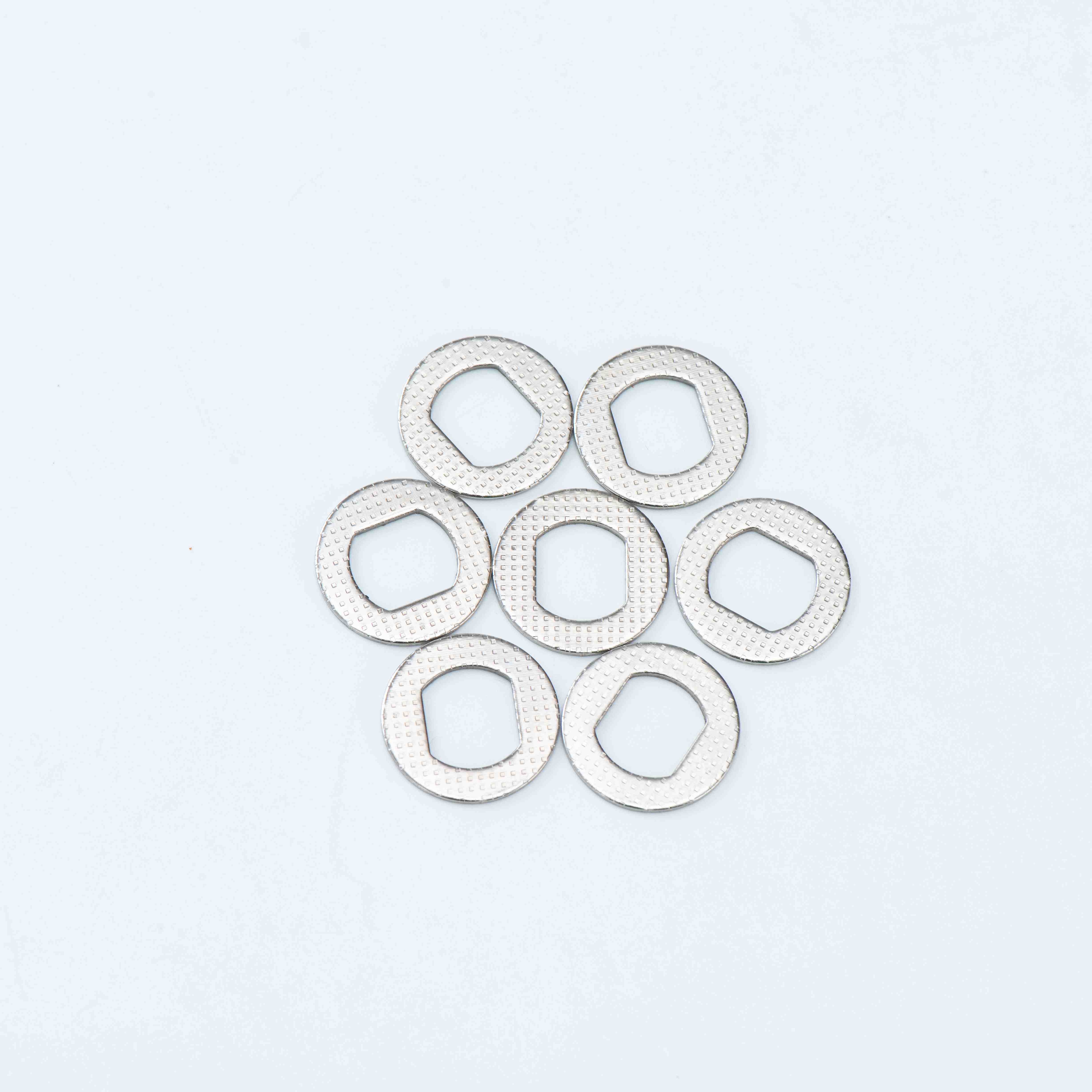
Because of their excellent positioning performance, torque hinges are widely applied in:
Laptop computers
Tablet PCs
2-in-1 notebooks
Automotive navigation displays
Medical diagnostic equipment
POS terminals
Industrial control cabinets
Smart home products
Portable monitors
Camera equipment
Lighting systems
Consumer electronics
As product designs become thinner and more sophisticated, manufacturers demand higher torque consistency and longer service life, making every internal hinge component increasingly important.
Why Do Torque Hinges Become Loose?
A torque hinge is a system composed of multiple precision components working together. Even if the hinge housing and shaft are manufactured accurately, poor-quality friction components can cause torque loss over time.
One of the most critical components is the oil storage friction washer.
Its primary functions include:
Generating stable friction torque
Maintaining smooth rotational movement
Reducing torque decay
Extending hinge service life
Improving long-term operating consistency
Without a properly designed friction washer, a hinge can quickly develop free play, unstable damping, or inconsistent rotational resistance after repeated use.
What Is an Oil Storage Friction Washer?
An oil storage friction washer is a specially engineered washer designed for torque hinge assemblies. Unlike an ordinary Flat Washer, it features precision oil storage points on one or both sides of the surface. These microscopic oil reservoirs help distribute lubrication evenly while maintaining consistent friction throughout continuous movement.
This small component directly influences the overall feel of the hinge and plays an essential role in preventing premature torque reduction.
Manufacturers developing high-performance hinge systems often rely on precision washer suppliers capable of producing tight tolerances, stable material properties, and customized specifications. Mengpeng Hardware specializes in precision washer manufacturing and supplies a comprehensive range of friction washers, flat washers, Hook Washers, Spring Washers, and custom hardware components for torque hinge applications. Their extensive product portfolio supports consumer electronics, automotive systems, medical equipment, and industrial machinery. Learn more about their precision hardware solutions at https://www.mengpengparts.com/.
Structural Features of Oil Storage Friction Washers
Although compact in size, every structural detail affects hinge performance.
Circular Profile
The washer is manufactured with a precision circular outer diameter suitable for compact hinge assemblies.
Precision Square Inner Hole
The square inner hole matches the hinge shaft profile, allowing both components to rotate together without slipping.
Oil Storage Surface
Depending on product requirements, manufacturers may choose:
Single-sided oil storage points
Double-sided oil storage points
These oil storage patterns help improve lubrication distribution while maintaining stable friction characteristics.
Thickness Options
Standard thickness typically ranges from 0.5 mm to 1.5 mm, allowing engineers to select specifications according to hinge structure and torque requirements.
Three Critical Manufacturing Factors
The long-term stability of a torque hinge depends heavily on manufacturing precision.
1. Inner Hole Tolerance
The square hole tolerance should remain within 0.02 mm.
If the hole is oversized:
Rotational play increases
Multi-stage torque appears
The hinge feels loose
If undersized:
Assembly becomes difficult
Friction increases excessively
Components may seize during operation
2. Concentricity and Symmetry
The concentricity between the inner hole and outer profile should remain within 0.05 mm.
Poor concentricity leads to:
Uneven rotation
Torque fluctuation
Inconsistent operating feel
3. Surface Flatness
Both sides of the washer should maintain flatness within 0.02 mm.
Insufficient flatness accelerates wear and significantly reduces hinge lifespan.
Materials and Manufacturing Process
High-quality oil storage friction washers are commonly manufactured using high-carbon spring steel materials, including:
65Mn
SK5
SK7
S50
C65
After precision stamping, the components undergo heat treatment to achieve a hardness of HRC 45–48, providing an excellent balance between wear resistance and elasticity.
Surface treatments may include:
Eco-friendly nickel plating
Electroless nickel
Chemical black nickel
Black zinc
Black oxide
Different coatings are selected according to environmental requirements and corrosion resistance expectations.
Choosing the Right Friction Washer
Selecting the correct friction washer involves more than matching dimensions.
Match the Structural Design
Choose the correct outer diameter, square hole size, and thickness based on the hinge design and available installation space.
Consider the Operating Environment
Different applications require different corrosion protection.
Indoor products
Eco-friendly nickel plating generally provides sufficient protection.
Humid environments
Electroless nickel improves corrosion resistance and extends service life.
Outdoor applications
High-performance coatings such as zinc-nickel alloy or Dacromet provide superior resistance to harsh environmental conditions.
Design for Long Service Life
Products requiring hundreds of thousands of opening and closing cycles should use optimized oil storage point distribution and appropriate oil storage volume to maintain consistent friction throughout the product lifecycle.