



 English
Direct Answer: Precision custom Flat Washers require tight dimensional control down to ±0.005mm thickness tolerance and burr limits below 0.02mm to maintain smooth axial spacing and prevent rotational friction imbalance in precision assemblies. Sourcing from an OEM stamping manufacturer with an existing library of 1,700+ tooling specifications can eliminate tooling charges and shorten prototype lead times from 3 weeks to 48 hours.
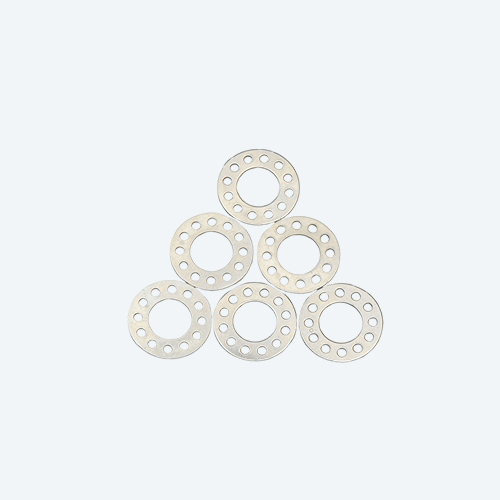
While off-the-shelf DIN or ANSI flat washers suffice for general construction Bolts, high-precision mechanisms—such as laptop hinges, automotive seat dampers, drone gimbals, and medical joints—demand tailor-made stamped washers. Even a slight variation in flatness or edge burr can cause inconsistent rotation torque, premature wear, or total assembly seizure.
Critical Engineering Tolerances for Precision Custom Flat Washers
Direct Answer: Thickness consistency across the entire washer face is the single most critical parameter, directly determining the axial preload and rotational resistance in multi-layered hinge mechanisms. Tight control over internal diameter (ID) prevents shaft wobbling, while concentricity ensures balanced mass distribution during high-speed rotation.
| Dimensional Parameter | Standard Stamping Tolerance | Mengpeng Precision Class | Impact on Mechanical Assembly |
|---|---|---|---|
| Thickness (T) | ±0.03 mm ~ ±0.05 mm | ±0.005 mm ~ ±0.01 mm | Dictates axial clearance and friction torque stack-up |
| Inner Diameter (ID) | ±0.05 mm | ±0.015 mm | Prevents radial play and off-axis shaft binding |
| Outer Diameter (OD) | ±0.08 mm | ±0.02 mm | Ensures housing clearance and uniform edge clamping |
| Flatness / Dish | ≤ 0.05 mm / 10mm | ≤ 0.01 mm / 10mm | Prevents uneven pressure hotspots and localized wear |
| Burr Height | ≤ 0.05 mm | ≤ 0.015 mm (Barrel Polished) | Eliminates scratching against adjacent rotating surfaces |
Need custom dimensions or ultra-thin gauges below 0.1mm? Explore our Precision Flat Washer Portfolio or send your 2D CAD prints directly to our engineering team for a 24-hour feasibility review.
Material Selection Guide: Balancing Hardness, Wear & Corrosion
Direct Answer: Spring steels (65Mn, SK5, SK7) provide superior surface hardness (HRC 44–52) and fatigue resistance for dynamic friction applications, whereas austenitic stainless steels (SUS301, SUS304) are required for non-magnetic or corrosive environments. Selecting the wrong grade leads to galling or loss of surface planarity over repetitive cycle testing.
| Material Grade | Typical Hardness | Primary Mechanical Strength | Recommended Application Scenario |
|---|---|---|---|
| SK5 / SK7 Carbon Steel | HRC 46 – 52 (Heat Treated) | Exceptional wear resistance & elastic recovery | Laptop hinges, rotary damper stacks, torque controls |
| 65Mn Spring Steel | HRC 44 – 50 (Quenched & Tempered) | High yield strength, cost-effective in bulk | Automotive interior hinges, folding brackets |
| SUS301 / SUS304 | HV 380 – 480 (Cold Rolled) | Corrosion resistance, non-magnetic stability | Outdoor electronics, medical instruments, marine joints |
| Phosphor Bronze (C5191) | HRB 75 – 95 | Self-lubricating, zero spark risk, low friction | High-frequency electrical contacts, delicate pivots |
How to Avoid Tooling Costs with Existing Factory Mold Libraries
Direct Answer: Prototyping custom washers typically incurs $800 to $2,500 in progressive stamping die charges, but sourcing from an established manufacturer with over 1,700 standard tooling sets allows engineers to match nearest-neighbor ID/OD combinations with zero upfront tooling investment. Stock die adaptation enables initial production batches within 2 to 5 days.
Dongguan Mengpeng Hardware maintains an active inventory of over 90 million precision components and more than 1,700 stamping die configurations. If your project allows minor adjustments to non-critical outer diameters (e.g., changing an OD from 8.15mm to a stock 8.00mm), you can bypass custom tooling charges entirely while maintaining your exact required internal bore and thickness.
When custom geometries like dual anti-rotation flats, locating tabs, or internal keyways are necessary, explore our companion Precision Hook Washer Solutions or combine them with our Spring Washer Stacks to maintain dynamic pre-compression.
OEM Sourcing Checklist: Information Required for a 24-Hour Quote
Direct Answer: To receive an accurate B2B production quote within 24 hours, procurement teams must supply 2D engineering drawings with geometric dimensioning and tolerancing (GD&T), raw material grade, surface finish type (e.g., barrel tumbling, nickel plating, black oxide), and target annual volume.
| Required Data Point | Preferred Format / Metric | Why It Matters to the Stamping Factory |
|---|---|---|
| 2D / 3D CAD Drawing | PDF + DXF / STEP file | Clarifies punch-to-die clearances and progressive stamping stations |
| Hardness & Heat Treatment | HRC or HV scale with range | Determines whether continuous mesh-belt furnace quenching is required |
| Surface Finishing & Salt Spray | e.g., Ni-plating ≥ 48h salt spray test | Prevents plating thickness buildup from altering tight bore tolerances |
| Batch Size & Annual EAU | Sample run vs. 500k+ annual pcs | Determines multi-cavity progressive tooling design vs. single-station stamping |
Have custom drawings ready for review? Contact the Mengpeng technical engineering department at Mengpeng Parts RFQ Portal or email your specifications directly to sale1@mphardware.com for a formal quote and DFM feedback within 24 hours.
Frequently Asked Questions (FAQ)
What is the minimum order quantity (MOQ) for custom flat washers?
If your dimensions match one of our 1,700+ existing die configurations, our MOQ starts at 5,000 to 10,000 pieces with available inventory for quick-turn sampling. For fully customized dimensions requiring a new progressive stamping mold, production MOQs typically begin at 50,000 pieces depending on part geometry.
Can you achieve a mirror finish or zero-burr edge on stamped washers?
Yes. Standard post-stamping processes include centrifugal barrel deburring, ultrasonic degreasing, and chemical vibratory polishing. For friction washers requiring smooth rotational touch, surface roughness can be held to Ra ≤ 0.2 μm with burr height under 0.015mm.
How does Mengpeng ensure thickness uniformity across high-volume orders?
We source precision cold-rolled strip steel with certified raw-material thickness tolerances of ±0.005mm. In-line automated optical inspection (AOI) sorting machines continuously verify thickness and outer profiles at speeds up to 1,000 pieces per minute prior to packaging.