



 English
If you need a flat or formed metal part that has to be identical across a hundred thousand units, custom metal stamping is usually the process that gets you there. It is fast, repeatable, and — once the tooling exists — the cheapest way to produce parts at volume. The catch is that stamping is a tooling business, not a machining business. The cost, the lead time and the quality ceiling are largely decided before the first part is made.
This guide is written for buyers and engineers evaluating a custom metal stamping manufacturer, especially when sourcing from China. It covers what stamping can and cannot do, how tooling drives your quotation, what belongs on a drawing, and the questions that separate a real stamping factory from a trading company.
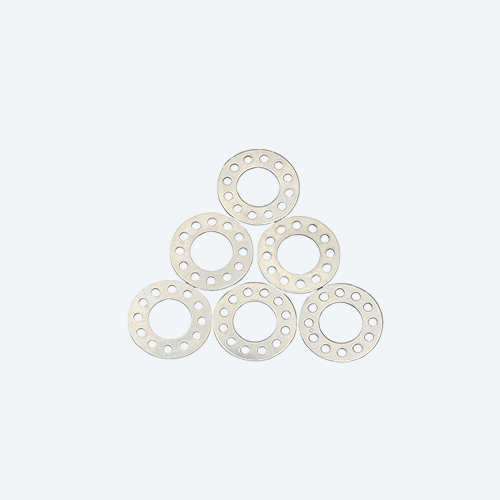
Custom stamped parts — perforated washers produced on a progressive die
What Custom Metal Stamping Actually Covers
Stamping is a family of processes, not a single machine. In practice, a custom stamping supplier will quote you one of four setups, and which one you get depends on volume, geometry and tolerance:
- Blanking — cutting a flat profile out of a coil or sheet, with no forming. This is how most washers, shims and gaskets are made.
- Piercing — punching holes, slots or perforation patterns into an existing blank.
- Forming and bending — turning a flat blank into a three-dimensional part with a press brake or a forming die.
- Deep drawing — pulling a flat blank into a cup or shell shape, used for housings, caps and covers.
Many parts combine several of these in one tool. A perforated washer, for example, is blanked and pierced in the same stroke. A hinge bracket may be blanked, pierced, bent and tapped. When a supplier understands your part as a sequence of stamping operations rather than a single step, you get a more honest quotation.
Stamping, Machining or Laser Cutting: Choosing the Process
Stamping is not always the right answer, and a good supplier will tell you so. The decision usually comes down to volume and tolerance:
Machining removes material one part at a time. It holds the tightest tolerances and is ideal for prototypes, low volumes and complex three-dimensional geometry, but the unit cost barely drops with quantity. Laser cutting is flexible and needs no tooling, which makes it attractive for one-off plates and brackets, but it is slow at scale and leaves a heat-affected edge.
Stamping needs tooling up front, but after that the per-part cost is a fraction of either alternative, and the process holds repeatability that manual methods cannot match. As a rule of thumb, stamping becomes the economic choice somewhere between a few thousand and a few tens of thousands of parts, depending on how complex the tool is. Below that, expect a supplier to recommend machining or laser cutting for the prototype stage and stamping for production. If your supplier quotes stamping for a 200-piece order, ask what happens to the tooling cost.
| Process | Up-front cost | Unit cost at volume | Best fit |
|---|---|---|---|
| Custom metal stamping | High (tooling) | Very low | Flat or formed parts at high volume |
| Machining | None | High | Prototypes, tight tolerances, complex 3D geometry |
| Laser cutting | None | Medium | One-off plates and brackets, no forming |
| Fine blanking | Very high | Low | Thick parts needing a sheared edge and tight tolerance |
The choice is rarely permanent. A precision metal stamping manufacturer will usually run your first samples by machining or laser, then cut the die once the design is frozen. What matters is that your metal stamping supplier in China is honest about which route your volume justifies, and that the custom stamped parts you receive in production match the samples you approved.
Materials Commonly Stamped
Almost any metal that can be supplied as coil or sheet can be stamped, but the material you choose affects tool life, springback and the finish you can achieve. The common choices are:
- Carbon steel (SPCC, SPHC) — the workhorse for brackets, shims and general hardware. Cheap, strong and easy to form, but it rusts unless plated.
- Stainless steel (304, 301, 430) — corrosion resistance without coating, widely used for washers and food-contact or outdoor parts. Harder on tooling than carbon steel.
- Spring steel (65Mn, 60Si2Mn) — used where the part must store energy, such as spring washers and retaining clips.
- Copper and brass — chosen for conductivity and appearance, common in electrical contacts and terminals.
- Aluminium (1050, 5052) — light and corrosion-resistant, but soft, so it marks easily and needs care in handling.
- Phosphor bronze and beryllium copper — for springs and contacts that need fatigue resistance and conductivity together.
Material thickness is usually quoted in the same breath as grade, because the two together decide which press the part will run on. Tell your supplier the temper as well as the alloy: half-hard and full-hard 301 stainless behave very differently in the same die.
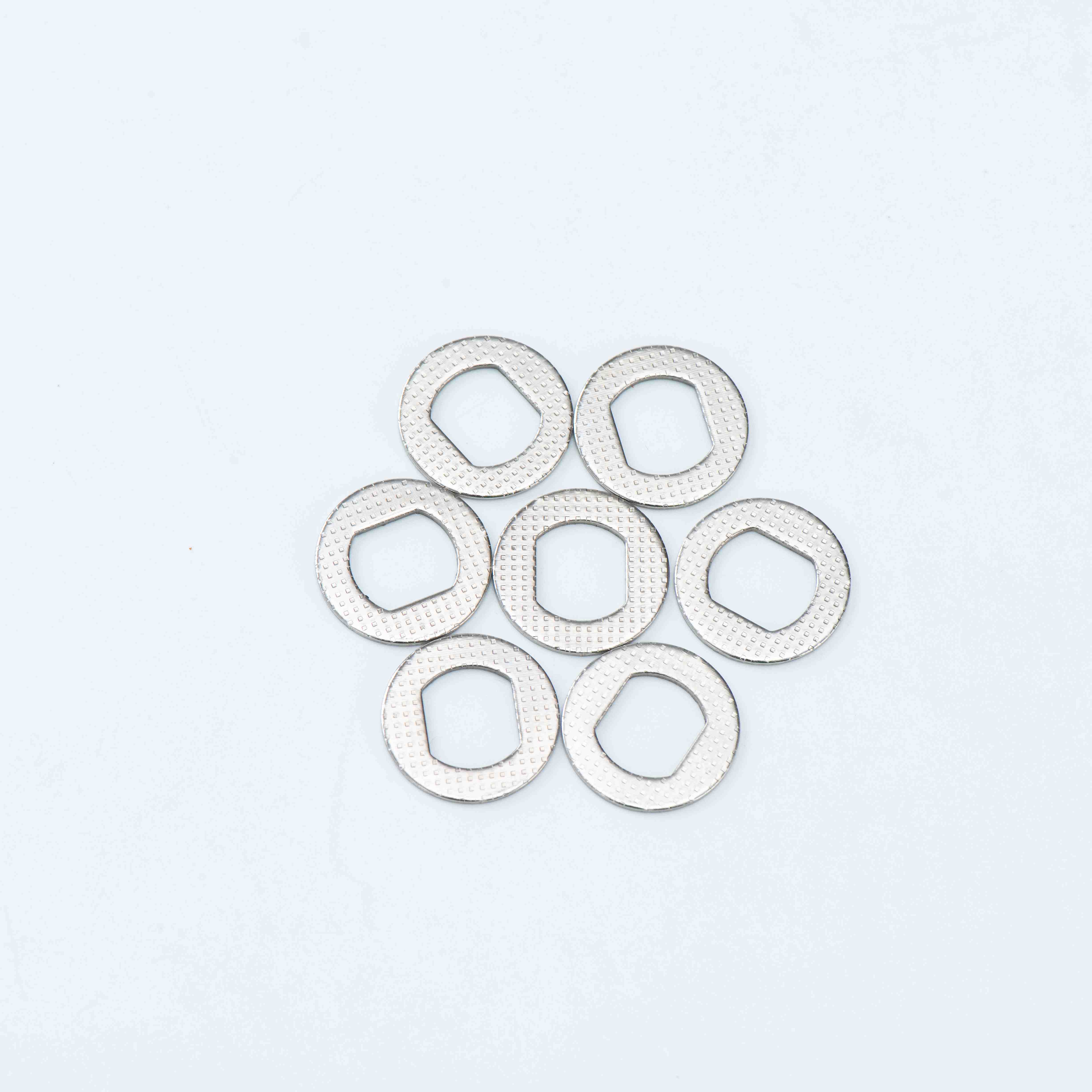
A blanked and pierced Flat Washer — one of the simplest custom stamped parts
Thickness, Tolerance and Press Capacity
Tolerance expectations have to match the process. A stamping supplier who promises machined-level tolerances on a thin blank is either misunderstanding the drawing or planning to machine it after all. The table below shows realistic shop-floor capability for a progressive-die stamping operation:
| Feature | Typical material thickness | Normal tolerance | Notes |
|---|---|---|---|
| Blanked profile | 0.10 – 6.0 mm | ±0.05 mm | Tighter on small features is possible with a fine-blanking die |
| Pierced hole | 0.10 – 6.0 mm | ±0.05 mm | Hole diameter should be at least the material thickness |
| Bend angle | 0.30 – 4.0 mm | ±1° | Springback grows with hardness and thickness |
| Flatness | 0.30 – 6.0 mm | 0.1 mm per 100 mm | Stress relief may be needed after forming |
| Burr height | any | ≤ 0.05 mm | Deburring is a separate, quotable operation |
If your design genuinely needs ±0.01 mm, say so early. It may push the part from a standard progressive die into fine blanking or a secondary machining step, and both change the price significantly.
Tooling: Where Your Cost and Lead Time Really Come From
The die is the single biggest driver of both your quotation and your schedule. A simple single-stage die for a Flat washer might take a week to build; a multi-station progressive die for a formed bracket can take four to eight weeks and cost many times more. This is why the first question a serious supplier asks is not "what is your target price" but "what is your annual volume".
There are three broad tooling options. A compound die performs blanking and piercing in one station and is ideal for flat parts at high volume. A progressive die moves the strip through several stations, adding holes and bends as it goes, and suits complex formed parts. A transfer die is used for larger parts where the strip cannot carry the workpiece. Each has a different cost curve, and the right choice depends on geometry and volume rather than preference.
Ask who owns the tool and where it is stored. On a serious order, the tooling should be built for your part, maintained between production runs, and available for inspection. If a supplier cannot tell you the number of stations in your die or the expected tool life in strokes, that is a warning sign.
Design Rules That Keep Stamped Parts Affordable
Most cost problems in stamping are designed in, not manufactured in. A few rules keep a part cheap to tool and cheap to run:
- Keep the wall between a hole and the part edge at least one material thickness; two is better.
- Make the hole diameter at least equal to the material thickness, so the punch does not snap.
- Keep bend radii at least one material thickness; sharper bends crack hard materials.
- Avoid tolerances tighter than the process can hold. Over-tolerancing is the most common way to double a stamping quote.
- Standardise hole sizes across a family of parts so one punch can serve several tools.
- Design symmetrical parts where possible — they feed and orient more reliably.
When a design does break a rule, a good supplier will say so at quotation stage and propose a fix, rather than tooling the part as drawn and charging you for the scrap later.
Secondary Operations You Should Expect
Few stamped parts ship straight off the press. Secondary operations are where a lot of the real cost sits, and a transparent supplier will itemise them rather than bury them in the unit price:
- Deburring and tumbling — removing sharp edges, often required for safety and fit.
- Plating and coating — zinc, nickel, black oxide or PVD, chosen for corrosion resistance or appearance.
- Heat treatment — hardening and tempering spring parts after forming.
- Tapping and threading — adding threads to a formed part.
- Assembly — riveting, staking or welding stamped components into a sub-assembly.
If your part needs two or three of these, ask for them as separate line items. It makes comparison between suppliers possible, and it lets you decide whether to move a step in-house.
Quality Control: What a Serious Stamping Supplier Measures
Stamping quality is about consistency, not about a single good sample. Ask how the supplier controls it:
- First-article inspection (FAI) — a full dimensional report on the first parts off a new tool, against the drawing.
- In-process checks — sampling at defined intervals, with the results recorded.
- SPC where it matters — statistical process control on critical dimensions, not on everything.
- Material traceability — mill certificates for the coil, so a material problem can be traced back.
- Final inspection reports — a dimensional and visual report shipped with the lot.
If your application is safety-related or regulated, ask about PPAP and the level of documentation the supplier can provide. A supplier who has never been asked for an FAI report is a supplier who has only served the domestic market.
How to Evaluate a Custom Metal Stamping Manufacturer
Price is the last filter, not the first. Before you compare quotations, check whether the supplier can actually hold your part. A search for "metal stamping supplier China" returns hundreds of names; the checklist below is how you narrow them down:
- Do they own their presses? A trading company will mark up a factory's price and add a communication layer. Ask for a video walkthrough of the press shop.
- Can they make the tool? In-house tooling means faster changes and someone accountable when a dimension drifts.
- Do they ask engineering questions? A supplier who questions your tolerance or material is engaged; one who quotes blindly is not.
- What is their sampling process? Ask for the FAI report of a similar part they have made.
- How do they handle a quality escape? The answer tells you more than any certificate.
For a broader view of what this kind of supplier produces, look at the range of stamped components they already run — flat washers, spring washers, hinge components and bolts all exercise different parts of the same press shop. A sheet metal stamping manufacturer who runs that variety is better equipped to handle your part than one who makes a single product line.
Common Sourcing Mistakes
A few mistakes show up again and again when buyers move a stamped part offshore:
- Quoting without a drawing. A sketch is not a specification. Without material, thickness and tolerances, every supplier is quoting a different part.
- Chasing the lowest unit price. A cheap unit price built on a fragile tool will cost more in downtime and rejects than it saves.
- Ignoring tool ownership. If you did not agree who owns the die, you may find yourself unable to move the part later.
- Forgetting secondary operations. A quote that omits deburring or plating is not comparable to one that includes them.
- Skipping the prototype. A small pre-production run on the production tool catches problems while they are still cheap to fix.
Each of these is avoidable with a short technical conversation before the order is placed.
Where to Start
Custom metal stamping rewards buyers who plan the tool, the material and the tolerance together. Bring a drawing with material, thickness, tolerances and annual volume, ask how the tool will be built and who will own it, and insist on a first-article report before mass production. That is the whole of it.
For related reading on the parts that come off the same presses, see our guides to custom washer manufacturing and friction hinge sourcing, or browse the full technical articles archive.
If you are sourcing stamped washers, brackets, terminals or Hinge Components, send us your drawing and volume. We will tell you honestly whether stamping is the right process, what the tool will cost, and what tolerance we can hold — before you commit to anything.