



 English
Sourcing a friction hinge is not the same as buying a hinge. A friction hinge is a torque-generating assembly: it must hold a panel at any angle without drifting, survive tens of thousands of cycles, and feel identical on unit 1 and unit 100,000. That consistency is a manufacturing problem, not a catalogue problem, which is why choosing the right friction hinge manufacturer matters more than the part number. This guide covers what to specify, how torque is controlled in production, and how to brief a supplier so the first sample matches the final shipment.
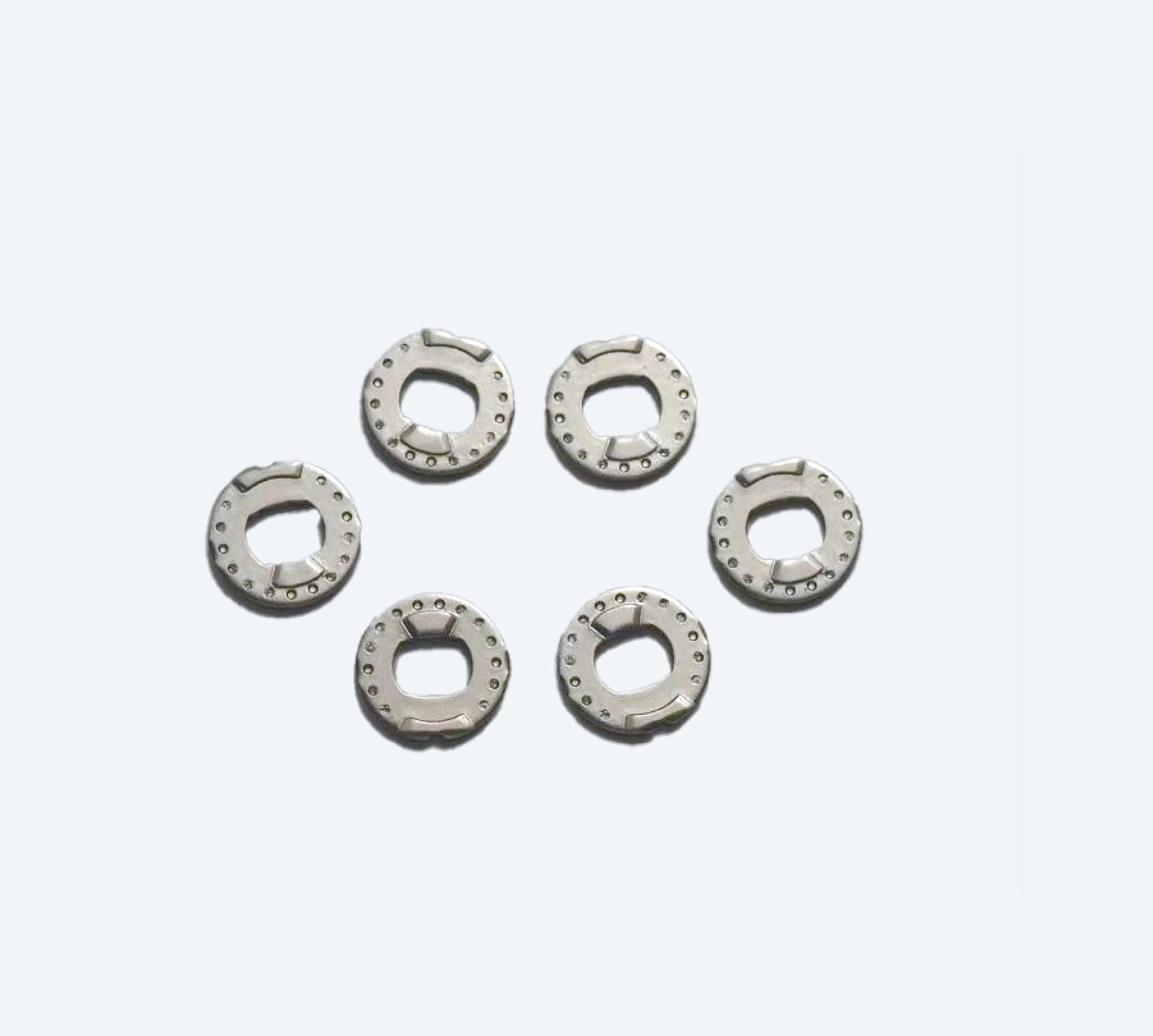
Cam washers with formed ramps and detent positions — the friction element that sets hinge torque.
What a Friction Hinge Does, and Why It Is Not Just a Hinge
A plain hinge has one job: allow rotation. A friction hinge has two: allow rotation and resist it. The resistance — the torque — is engineered. It comes from controlled interference between a cam, a friction Washer, and a shaft, and it is what lets a laptop lid stay at 45 degrees, a car armrest hold position, or an appliance door stop where you leave it.
That distinction changes the sourcing conversation. For a plain hinge you buy a geometry. For a friction hinge you buy a torque curve plus a durability guarantee — and both are properties of the manufacturing process, not the drawing alone.
Friction Hinge vs torque hinge vs Free-Stop
Buyers use these terms loosely, and suppliers quote them differently. The table below separates the mechanisms so you can specify the right one.
| Type | How it works | Behaviour | Typical use |
|---|---|---|---|
| Friction hinge | Constant interference between cam/washer and shaft | Holds any angle, smooth resistance | Laptop lids, monitors, POS terminals |
| Torque hinge | Same principle, torque value specified and tested | Defined holding torque in N·m | Automotive interiors, medical arms |
| Constant torque hinge | Cam profile tuned to flatten the torque curve | Nearly equal torque across the full range | Heavy lids, equipment covers |
| Detent hinge | Cam ramps create discrete positions | Snaps to set angles, free between | Appliance doors, seating |
| Free-stop hinge | High friction with a defined release | Holds, then moves freely when pushed | Convertible devices, flip panels |
Most custom projects land between friction and constant torque. The choice is driven by how sensitive the user is to a change in feel as the panel swings — a laptop user notices, an equipment cover operator usually does not.
How Hinge Torque Is Measured and Specified
Hinge torque is expressed in newton-metres (N·m) or kilogram-force centimetres (kgf·cm), and it is always a range, never a single number. A specification that reads "2.5 ± 0.4 N·m at 20 °C, measured at 30 degrees per second, after 5 cycles" tells a manufacturer exactly what to build and test. One that reads "stiff" does not.
Three details decide whether a torque specification is usable:
- Measurement point. Torque read at the start of travel differs from torque at the end. Specify where it is measured.
- Cycle condition. New-part torque and post-cycling torque differ. Friction settles. State whether the value applies to a fresh unit or after a defined number of cycles.
- Test speed and temperature. Friction is rate- and temperature-sensitive. A hinge that meets torque on the bench can miss it in a hot enclosure.
A supplier that asks for all three is a supplier that has done this before. If a quotation arrives without any question about test conditions, treat the number as an estimate.
The table below gives indicative torque and cycle-life ranges by application. Use it to sanity-check a specification, not to replace testing — the real value always comes from the panel weight and the user's tolerance for drift.
| Application | Typical holding torque | Typical cycle-life target |
|---|---|---|
| Laptop lid | 1.5 – 3.0 N·m | 20,000 – 30,000 cycles |
| Monitor or display arm | 3 – 8 N·m | 10,000 – 20,000 cycles |
| Home appliance door | 5 – 15 N·m | 30,000 – 50,000 cycles |
| Automotive armrest or screen | 2 – 6 N·m | 30,000+ cycles |
| Industrial equipment cover | 8 – 20 N·m | 10,000 cycles |
Inside a Friction Hinge: The Parts That Create Torque
The torque does not come from the housing — it comes from the internal stack. Understanding the stack is how you control cost and consistency.
- Cam. A profiled disc, often a cam gasket, that converts axial spring load into rotational resistance and, in detent designs, defines the holding positions.
- Friction Washer. The wear surface. Material and surface texture set the friction coefficient, which is why a friction washer is usually phosphor bronze or a treated steel rather than plain carbon steel.
- Shaft. Carries the stack and transfers torque to the moving panel. Shaft geometry and hardness determine wear life.
- Spring or Belleville washer. Provides the axial preload that keeps the stack in contact. A Belleville washer is common because it delivers high load in a short stack height.
- Retaining and damping elements. A retaining washer holds the stack together; a damping washer smooths motion and reduces noise.
Every element in the stack is a tolerance contributor. That is the core reason friction hinge consistency is a manufacturing discipline: the assembly inherits the variation of five or six stamped and machined parts.
What Makes a Friction Hinge Design Work in Production
Good friction hinge design is not about a clever mechanism — it is about making the mechanism repeatable. Four design decisions separate a prototype that works from a product that ships:
- Tolerance allocation. Torque is the sum of interference across the stack. If every part is specified at its widest tolerance, torque spread will be too large to control. Critical faces need tight tolerance; non-critical ones should be loosened to cut cost.
- Material pairing. Friction coefficient depends on both surfaces. Specifying the washer material without specifying the mating shaft material leaves torque undefined.
- Lubrication strategy. Some designs rely on a dry film or grease to stabilise friction over life; others avoid lubricant entirely. This must be decided before tooling, not after.
- Cycle-life target. A hinge rated for 10,000 cycles and one rated for 50,000 cycles can look identical on a drawing and differ completely in material and hardness.
This is where an experienced hinge components supplier earns its place — by flagging a design that will drift in the field before the die is cut.
How to Brief a Friction Hinge Manufacturer
A brief that answers these questions will produce an accurate quotation and a sample that needs minimal iteration.
- Torque target and tolerance in N·m or kgf·cm, with the measurement condition.
- Rotation range in degrees, and whether the full range needs holding torque.
- Cycle life and the acceptable torque drop over life.
- Panel weight and centre of gravity — the load the hinge must actually hold.
- Space envelope: maximum length, diameter, and stack height.
- Environment: temperature range, humidity, corrosion exposure, and any cleaning chemicals.
- Annual volume, which decides tooling approach and unit cost.
- Assembly method and any automatic insertion requirement.
If the project is still at concept stage, send the panel weight and the target feel. A manufacturer can propose a torque value and a stack configuration from that alone, then refine it once the envelope is fixed.
Standard or Custom Friction Hinges?
Off-the-shelf torque hinge assemblies exist and are the right answer when the envelope, torque, and cycle life all happen to match. They are fast and cheap to start with, and they are a legitimate way to validate a concept.
The switch to custom comes when any of the following is true: the torque target sits outside the standard range, the mounting geometry does not match, the cycle-life requirement is higher than a stock part is rated for, or the assembly must fit a defined stack height. At that point the stock part is no longer cheaper — it just moves the cost to rework.
Custom friction hinges are built from the same elements as standard ones, so tooling is usually limited to a cam profile and a stamped washer rather than a full assembly. That keeps the investment moderate and makes custom viable at volumes well below what most buyers expect.
Quality Checks That Predict Field Performance
Two hinges can pass a visual inspection and behave completely differently after a month. The checks that actually predict performance are measurable:
- Torque before and after cycling. The torque drop over the rated cycle count is the single most useful number.
- Dimensional control on the stack. Thickness and flatness of the friction elements drive torque spread.
- Hardness verification. Surface hardness of the shaft and washer sets wear rate.
- Material certificates. Documented grades for bronze and stainless, not verbal assurance.
- Sampling plan. First article, pilot lot, and production inspection at defined intervals.
Ask for the torque-versus-cycles curve, not just a single pass or fail. A supplier that tracks the curve understands what it is selling.
Where Friction and Torque Hinges Are Used
The applications share one trait: the user interacts with the position of a panel, and that position must feel deliberate.
- Consumer electronics. Laptop lids, monitors, and convertible devices where feel is part of the product.
- Automotive interiors. Armrests, display screens, and storage lids that must hold position under vibration.
- Home appliances. Oven and refrigerator doors that stop at an angle instead of falling open.
- Furniture and fixtures. Cabinet flaps, seating backs, and adjustable panels.
- Medical and industrial equipment. Articulating arms, covers, and access panels where position stability is a safety requirement.
In every case the hinge is doing functional work. That is why the manufacturer's process control matters as much as the design.
Frequently Asked Questions
How do I choose between a friction hinge and a torque hinge?
Use the term your performance requirement implies. If the requirement is "holds any angle smoothly," specify a friction hinge. If the requirement is a defined holding value that must be tested, specify a torque hinge. Most suppliers build both from the same stack and will accept either specification.
Can adjustable friction hinges be tuned after assembly?
Some designs allow torque adjustment through a set screw or a nut that changes spring preload. Adjustable friction hinges — often listed as adjustable torque hinges — are useful where the final panel weight is not known at hinge design time, or where field service needs to restore torque. Fixed designs are simpler, cheaper, and more consistent, so use an adjustable design only when the adjustment is genuinely needed.
What is a constant torque hinge used for?
A constant torque hinge maintains nearly the same resistance through the full rotation range. It is used where a user would notice the hinge getting easier or harder as the panel swings — typically heavy lids and equipment covers. Achieving a flat torque curve requires a tuned cam profile, which is why it is usually a custom part.
How many cycles should a friction hinge last?
It depends on the product. Consumer electronics commonly target 20,000 to 30,000 cycles; automotive and appliance applications often specify more. The number matters less than the torque tolerance at the end of life — specify the acceptable torque drop, and let the manufacturer select materials to meet it.
Sourcing Friction Hinges Without Guesswork
A friction hinge is a torque specification wrapped in a manufacturing process. Get the specification right, and the supplier can hold it; leave it vague, and the field will find the variation for you. The manufacturer worth partnering with is the one that asks about cycle life and test conditions before quoting, and that controls the internal stack — cam, friction washer, shaft, and spring — under one roof rather than assembling parts from three vendors. If you are developing a hinge assembly and need the torque to hold from the first unit to the last, send your panel weight, envelope, and torque target and we will come back with a stack proposal.