



 English
How Does a Cam Washer Work? Positioning and Self-Locking Mechanism Explained
A Cam Washer is a precision mechanical component designed to work together with a Cam Plate to achieve accurate positioning, automatic return, and self-locking functions in rotary hinge systems. Unlike ordinary washers, a cam washer plays an active role in controlling rotational movement and maintaining stable torque performance.
In modern products such as laptop hinges, automotive interior mechanisms, medical equipment, monitor brackets, and industrial devices, the combination of a Cam Washer and Cam Plate provides smooth operation, precise angle positioning, and reliable long-term performance.
The performance of a torque hinge system depends not only on the hinge structure itself but also on the
precision design, material selection, surface treatment, and manufacturing accuracy of the internal
components. As one of the key Torque Hinge Components, the Cam Washer directly affects
operating feel, holding torque, durability, and product reliability.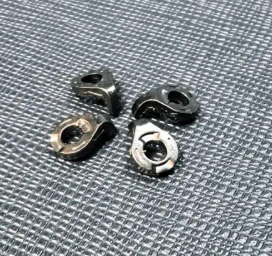
What Is a Cam Washer?
A Cam Washer is a specially designed metal washer with a three-dimensional cam surface that works with a matching Cam Plate. Through the interaction between the cam profiles, rotational motion can be converted into controlled axial movement, creating stable positioning points during operation.
Unlike standard Flat Washers that only provide spacing or load distribution, a Cam Washer is a functional precision stamping part. It is responsible for generating resistance, maintaining contact pressure, and creating a controlled rotational torque inside hinge assemblies.
A typical cam mechanism consists of several components:
Cam Washer
Cam Plate
Wave Spring Washer
Rotating Shaft
Flat Washer
Fastening Components
During assembly, the wave spring applies continuous pressure between the Cam Washer and Cam Plate. This preload ensures that the two cam surfaces remain tightly engaged throughout the entire operating process.
How Does a Cam Washer Work with a Cam Plate?
The working principle of a Cam Washer is based on the precise cooperation between the three-dimensional cam surface and the matching profile of the Cam Plate.
When the hinge begins to rotate, the raised section of the Cam Washer moves along the inclined surface of the Cam Plate. Because the cam profile has different heights, the rotational movement creates an axial lifting force that compresses the spring inside the hinge structure.
As the Cam Washer passes over the highest point of the cam profile, the stored spring force pushes the
washer into the next recessed position. This movement creates a clear positioning feeling and allows the
hinge to stay securely at a specific angle.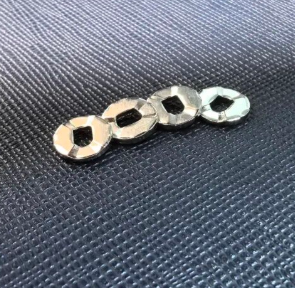
The complete working process includes:
Initial Position: The Cam Washer and Cam Plate are fully engaged, maintaining a stable resting position.
Rotation Movement: External torque forces the Cam Washer to climb along the Cam Plate profile.
Spring Compression: The wave spring is compressed while storing elastic energy.
Position Switching: After passing the cam peak, spring force pushes the Cam Washer into the next positioning groove.
Stable Locking: The new position is maintained until sufficient external torque is applied.
How Does a Cam Washer Achieve Self-Locking?
The self-locking function of a Cam Washer is not achieved by a single factor. It is the result of the combined effects of mechanical geometry, spring preload, and friction force.
1. Mechanical Locking Through Cam Geometry
The specially designed cam profile creates resistance between each positioning point. Without enough external force, the Cam Washer cannot easily move over the cam peak, preventing unwanted rotation.
The angle, height, and shape of the cam profile directly influence:
Operating torque
Positioning accuracy
Click feeling
Self-locking ability
2. Continuous Pressure from Wave Spring
The wave spring provides constant axial force, keeping the Cam Washer and Cam Plate closely connected.
This preload is essential because it prevents:
Unexpected movement caused by vibration
Position shifting during use
Loss of torque after repeated operation
3. Friction Resistance Between Contact Surfaces
The pressure generated by the spring creates friction between the Cam Washer and Cam Plate surfaces. This friction force improves holding torque and helps maintain stable positioning performance.
Therefore, the self-locking performance of a Cam Washer system depends on the balance between:
Cam profile design
Spring force
Surface friction coefficient
Material hardness
Manufacturing precision
Structural Features of a Cam Washer
A high-quality Cam Washer usually has a circular structure with specially formed functional areas to ensure accurate installation and stable operation.
| Feature | Description |
|---|---|
| Overall Shape | Circular metal washer structure |
| Center Hole | Precision inner hole for shaft assembly |
| Locating Ears | One or two bent tabs for positioning and assembly |
| Cam Surface | 3D recessed profile designed to match Cam Plate |
| Material Thickness | Normally 1.2mm - 1.5mm depending on application requirements |
The three-dimensional cam surface is the most important functional area of the Cam Washer. Its accuracy directly affects automatic closing, return performance, torque stability, and service life.
Key Manufacturing Control Points
Because the Cam Washer directly determines hinge performance, strict dimensional control is required during stamping, forming, heat treatment, and surface finishing processes.
Inner Hole Dimension Control
The inner hole is directly related to assembly accuracy and rotation stability. The tolerance should normally be controlled within:≤ 0.05mm
Bending Accuracy
The locating ears or bent hooks must maintain precise forming quality.
No compression marks on the inner bending area
No cracks on the outer bending surface
Bending width tolerance controlled within 0.02mm
3D Cam Surface Accuracy
The concentricity and symmetry between the 3D cam surface and the center hole are critical quality requirements.
Recommended tolerance:≤ 0.05mm
Poor concentricity may cause unstable automatic closing, inconsistent return performance, and excessive torque fluctuation.